
Discover Smartwool
Découvrez la marque Smartwool et leurs essentiels en mérinos pour bien affronter le froid.

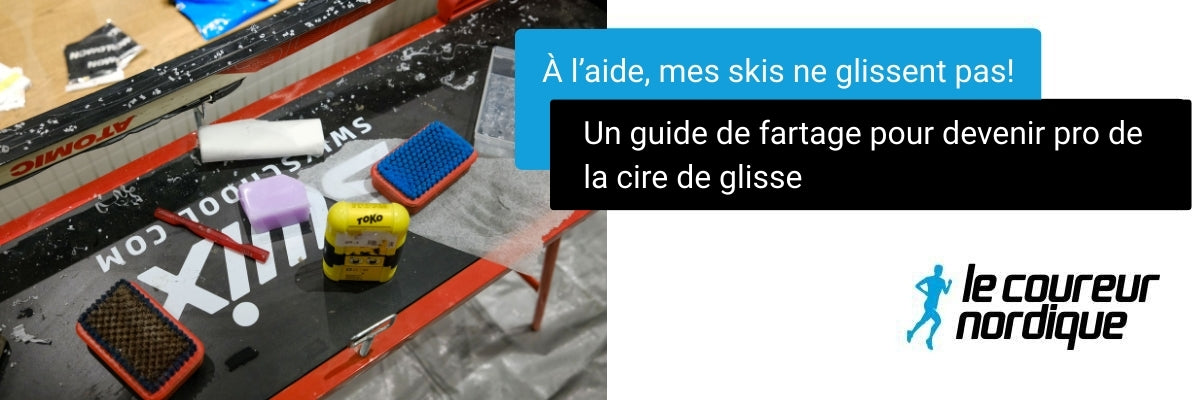
You're cross-country skiing with your friend who's a pro on the slopes, and he leaves you in the dust on every descent. Sound familiar?
Sooner or later, there comes a time when, despite your best efforts, your skis simply refuse to move forward. Fresh snow, wet snow, fluctuating temperatures, a dry base… there are many possible causes. The good news is that this problem can often be solved with better maintenance using glide wax.
Glide wax has three main functions:
And contrary to popular belief, there are solutions for every skill level. Here’s how to navigate the products available in stores.
For whom:
Universal liquid wax is the perfect place to start. It’s applied directly to the base, dries in a few minutes, and greatly improves glide with minimal effort. It works in a wide variety of conditions, without the need for an iron or scraper. It’s simple and effective, but its durability is still inferior to that of hot waxes.
How to use it :


Typical hot wax application process:
For whom:
At this level, waxing becomes a true optimization process. Factors such as snow temperature, humidity, crystal type, and even the structure of the base are taken into account.
This level generally involves:
The goal is to minimize friction as much as possible under specific snow conditions.
Here are some common signs that indicate when it’s time to reapply glide wax:
Whether you’re a beginner or looking to optimize your performance, there’s a solution that’s right for you. Glide wax isn’t just about speed—it’s also a way to protect your skis and make skiing more enjoyable.
Happy skiing!
Découvrez la marque Smartwool et leurs essentiels en mérinos pour bien affronter le froid.

In 2026, the adidas Adizero Adios Pro EVO 3 made a big entrance at the London Marathon, on the feet of Sabastian Sawe. Weighing under 100 grams and packed with...


Aux Lièvres: an urban rally to kick off the festivities


Running through winter in Québec City can seem intimidating at first, especially with the cold, the snow and sometimes slippery surfaces. But with the right adjustments, winter running is not...

Choosing the right shoes is essential for keeping your feet warm and preventing you from slipping on snow and frozen ground. Whether you’re walking, road running, or trail running in...

Cross-country skiing is the perfect way to enjoy Québec winters, whether you want to unwind in nature or train on technical trails. With three different styles of cross-country skiing, classic,...